Two frameworks, one goal: build apps for every platform
When it comes to building mobile applications that work on both iOS and Android, two frameworks have dominated the conversation for years: Flutter and React Native. Both allow development teams to write a single codebase and deploy it across platforms, saving time and resources compared to building separate native apps.
But while they share the same end goal, they take very different approaches to get there — and those differences have real implications for performance, design flexibility, and long-term maintainability. Let's take a closer look at what sets them apart.
The rendering engine: Flutter's core advantage
One of the most fundamental differences between the two frameworks lies in how they render UI. React Native relies on a JavaScript bridge to communicate with native components, which can introduce latency and inconsistencies depending on the platform.
Flutter takes a completely different approach: it uses its own high-performance rendering engine, Skia (and more recently Impeller), to draw every pixel directly on the canvas. This means Flutter doesn't depend on platform-native components at all — it renders everything itself, resulting in smoother animations, more consistent behavior across devices, and significantly better performance in visually complex interfaces.
According to various performance benchmarks and developer surveys, Flutter apps tend to achieve more stable frame rates and lower jank rates than their React Native counterparts, particularly in animation-heavy or custom-designed applications.
Custom design: pixel-perfect interfaces with Flutter
If your product requires a highly tailored visual identity — custom animations, unique UI patterns, brand-specific components — Flutter is the clear winner. Because it doesn't rely on native OS widgets, designers and developers have complete freedom over every visual element.
React Native, by contrast, wraps native components, which means the UI is inherently tied to what each platform provides. Achieving a truly custom look often requires workarounds, third-party libraries, or platform-specific code that can be time-consuming and brittle.
Flutter's widget system is built from the ground up to be composable and customizable. This makes it an ideal choice for studios and agencies that prioritize design quality and need pixel-perfect results across all devices.
Growing adoption: Flutter is gaining serious momentum
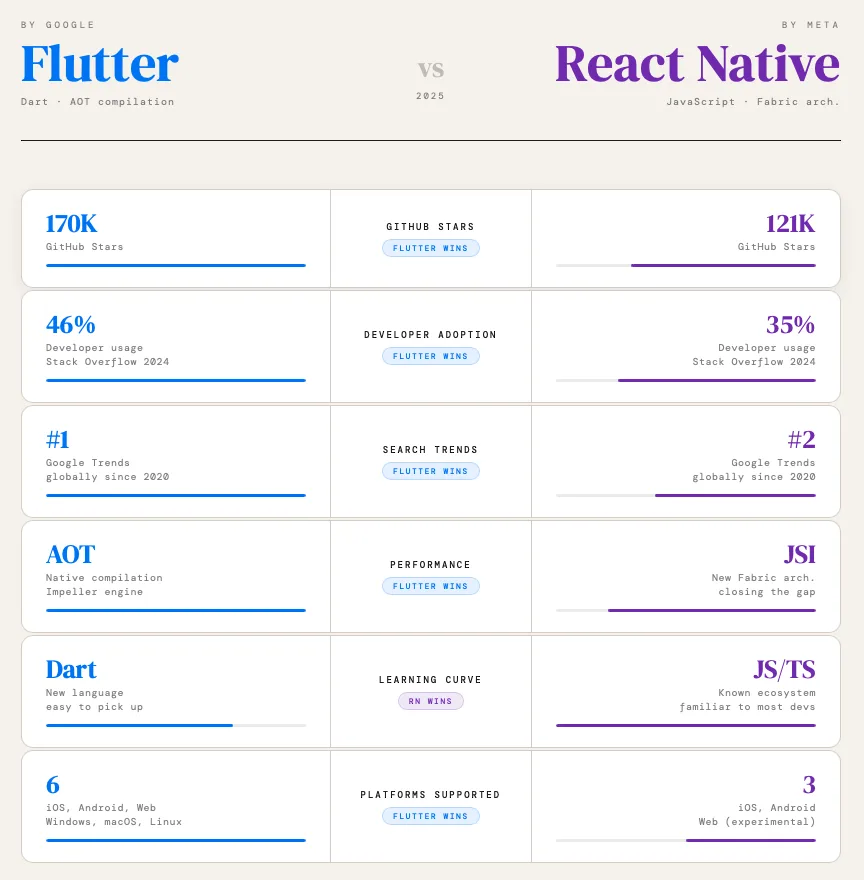
Flutter's rise in adoption has been remarkable. According to the Stack Overflow developer survey, Flutter has consistently ranked among the most loved and widely used cross-platform frameworks in recent years, surpassing React Native in several metrics.
Major companies including Google, BMW, Alibaba, and eBay have shipped production applications built with Flutter. This level of enterprise adoption signals not just technical maturity, but also a growing ecosystem of tooling, packages, and community support.
The Flutter ecosystem now includes robust support for mobile, web, desktop, and even embedded devices — making it one of the most versatile UI frameworks available today.
React Native: still a solid choice, but with trade-offs
This isn't to say React Native lacks merit. If your team already has strong JavaScript and React expertise, React Native offers a lower barrier to entry and a large library ecosystem through npm. It also benefits from Meta's continued investment and a long-standing community.
However, the JavaScript bridge architecture has long been a source of performance issues, and while the new JSI (JavaScript Interface) architecture addresses some of these concerns, it still doesn't match the out-of-the-box performance and rendering consistency that Flutter provides.
For projects where speed of development takes priority over visual polish or maximum performance — such as internal tools or MVPs with simple UIs — React Native can still be a practical choice.
How Liquid Studio can help you build with Flutter
At Liquid Studio, we've been building production Flutter applications for years. We've seen firsthand how the framework enables faster iteration, better design fidelity, and smoother performance — especially for products where the user experience is a key differentiator.
Whether you're starting from scratch, migrating from another framework, or looking to scale an existing Flutter app, our team has the experience to guide you through every stage of development. If you're weighing your options or ready to get started, we'd love to hear about your project.
