This year AI agents have started taking on problems that had been open for decades. In September, OpenAI announced that around ten thousand coordinated agents had resolved the Navier-Stokes problem, one of the Millennium Prize Problems, and published the proof formalised in Lean so a machine could check it. The Clay Mathematics Institute described it as apparently settled, pending an evaluation it will take its time over. A month later came a proof of a weaker version of the Riemann hypothesis.
In all of these cases the answer can be checked. At Liquid Studio we wanted to take our own agent experiments in that direction, on a small scale: find a hard problem with a verifiable solution and set a team of AI agents on it. This piece explains how we built it and what came out, for anyone who works with agents or is thinking about it.
The puzzle: the last stage of GSMG.io
GSMG.io is a cryptographic puzzle published in 2019. Whoever solves it gets the private key to a bitcoin address. It was announced with a 5 BTC prize, which halves with every bitcoin halving, and the address now holds about 1.25.
It starts with a grid of coloured squares that, read as binary, leads to the next stage. After that come ciphers, clues hidden in images and references to The Matrix. The community has solved every intermediate stage, but the last step, two AES-encrypted blocks, has gone unsolved for years.
That makes it a good test bed. A password either decrypts the block or it doesn't, and anyone can check it on a laptop. It is the same principle as a proof in Lean, at a fraction of the cost.
Five roles for a team of AI agents
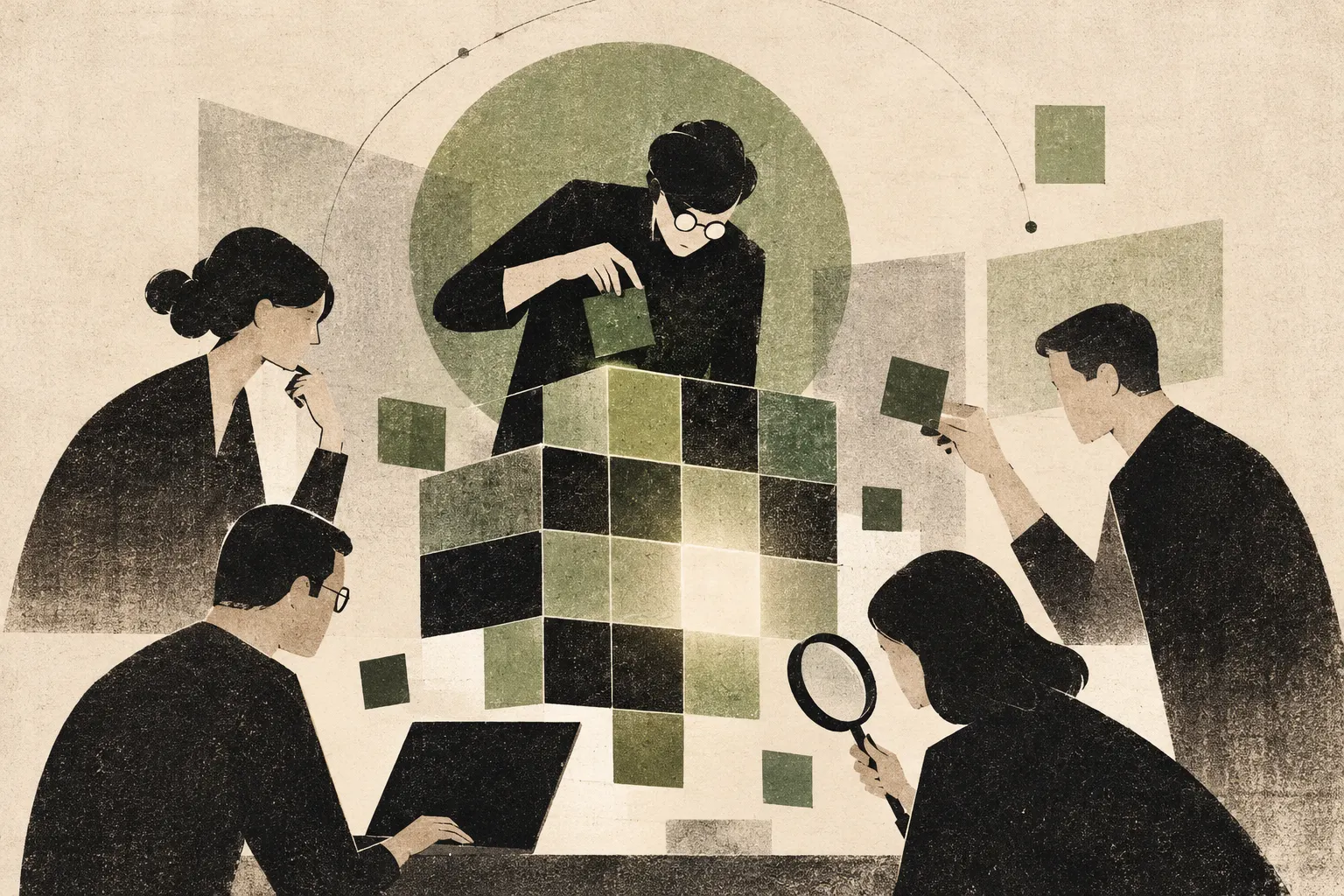
I started by asking which profiles we would hire if we had to solve it with people, and ended up with five. The creative reads references, tries to think like the puzzle's author and proposes new readings. The cryptanalyst handles the ciphers: technical tests, keys, structures. The toolsmith turns ideas into code and runs it. The sceptic accepts nothing until they have reproduced it themselves. The archivist remembers everything so the team doesn't repeat work.
Above them sits an orchestrator acting as team lead: it reads how the investigation is going and hands out the tasks. Two decisions sit behind this. Every task is run by a fresh agent with no memory of the earlier ones, so nobody inherits someone else's assumptions. And nothing counts as a finding until the sceptic has reproduced it.
How the agents are orchestrated, round by round
The system works in rounds. At the start of each one, the orchestrator reads the state of the investigation, decides what is worth trying and splits it into cards. These are small worksheets, each with a specific question, who should do it and what counts as done. A fresh agent picks up each card, does the work and writes up the result. At the end of the round, the orchestrator reads everything and starts again.
A card might read: "Creative, read the message in the 2021 transaction and say what it suggests about the prize key." The agent returns a hypothesis. In a later round, another card hands it to the sceptic: "Reproduce this from scratch and say whether it holds." If it holds, it becomes a finding. If not, it is logged as a dead end and nobody tries it again.
Everything is stored in a few shared files. The digest summarises the state of the investigation and is what the orchestrator reads at the start of each round. The treasures are the findings the sceptic has confirmed. The tested file lists what has already been tried without result. The job queue holds the heavy computations, which run in the background while the agents carry on.
What the team of agents found
The team has not opened the two AES blocks, which the community hasn't managed in years either. It has, however, rigorously ruled out more than a hundred dead ends and found two treasures: two real pieces of the puzzle's structure that the sceptic reproduced before accepting them.
The first comes from the blockchain. In 2021, with the hunt stuck, the author sent a transaction carrying a message: "GSMG.io neighbors, half and double". A creative agent worked out what it meant: the four addresses it pays are the prize key with +1, −1, ×2 and ÷2 applied. Its conclusion was that this signalled the final answer is a raw number and not a hash. The sceptic redid it from scratch and signed it off without reservations, because all four relations reproduced exactly. The author had left a worked example of the arithmetic needed at the end in plain sight.
The second is a hidden structure. One of the lines on the last page is a string of letters, and a cryptanalyst found it is built on prime numbers and the yellow and blue colours from the first stage. The sceptic tested it against 100,000 randomly shuffled versions, and none reproduced the pattern. Its verdict was that the structure is deliberate, and it also noted that we still don't know where it points.
What this experiment brings to real projects
What we take from this experiment is mainly a way of organising work. Splitting a problem into small tasks with a clear definition of done, separating whoever proposes from whoever validates and keeping a record of what has been ruled out works just as well for a code migration, an audit or a data analysis. It is the same idea we applied when we put several AI agents to work on the same project, where whoever writes the code doesn't approve it.
It is also what we see in the artificial intelligence projects we build for clients. A good part of the work lies in the system around the model: how tasks are split, what is kept between one task and the next and how its output gets checked.
What it would take to go further
All of this ran under two tight limits. One was a small budget, which stopped the team mid-task. The other was a single machine, a laptop, where the heavy checks were slow. With a bigger token budget and the job queue on a machine with a good GPU, the same system could try many more paths in the same time. If the solution exists and is within reach, it would have a real chance of finding it.
Watching 2026's AI take on problems that seemed reserved for the best minds is a little unsettling, and it is natural to wonder what it means for our trade. I don't have the answer. What we are clear about at Liquid Studio is that we want to know these tools first-hand, through experiments like this one, so we can apply them with judgement to everyday work.
