When a company gets in touch to build or rebuild its online store, the decision often arrives half made. Some have heard that Shopify is the fast, cheap option and want to go straight there, while others assume a company their size needs something custom-built. Both ideas are partly right, but neither is enough to decide without first looking at how the business sells.
We build e-commerce of both kinds, so we have no particular reason to push towards either one. What we have seen is what happens when the choice goes wrong. A custom store for a simple catalogue ends up expensive to maintain for what it delivers, and a Shopify store stretched to cover operations that don't fit ends up full of patches.
When Shopify fits
Shopify works really well when you sell to consumers, with a catalogue and checkout process similar to most stores. Payments, shipping, inventory and security come ready-made and Shopify keeps them maintained, which is a lot of work you don't have to pay for or keep an eye on.
It also fits when there's a rush to launch. A well-built Shopify store can be selling quite a bit sooner than one developed from scratch, and that matters when there's a season or a campaign marked on the calendar. And it fits when the team wants to run the store themselves, adding products, changing prices or launching a discount without having to call anyone.
For whatever isn't built in, there's usually an app. The ecosystem is huge and covers most common needs. Shopify also sits perfectly well alongside custom work. On top of the platform you can build your own themes, integrations with your ERP or logistics, and specific features the business needs, so a Shopify store can have a fair amount of development behind it too.
When custom development makes sense
Custom development starts to make sense when the way you sell doesn't fit in a standard store. That happens with prices that change by customer or volume, products configured piece by piece before purchase, bookings for dates or places, subscriptions with their own rules, or different catalogues depending on who logs in. Each of these can be handled in Shopify with apps or development, but when several of them come together, the store starts fighting the platform.
B2B portals are the clearest case. A distributor buying on agreed terms, orders that need approval, per-customer pricing or payment on credit usually call for something designed around that way of working. The same applies when the store has to talk in depth to the ERP, the warehouse or internal systems. There are also projects where content matters as much as sales, such as brands that explain their product in depth or stores that live alongside a large content site, and there a platform built for flexible content management tends to give you more room.
There's one sign worth watching in any growing store. If you keep adding third-party apps to cover what's missing, each with its own monthly fee and its own way of doing things, there comes a point where it's worth stopping to run the numbers. Sometimes the answer is to carry on as you are, and sometimes it's to build one piece of your own that replaces several apps at once.
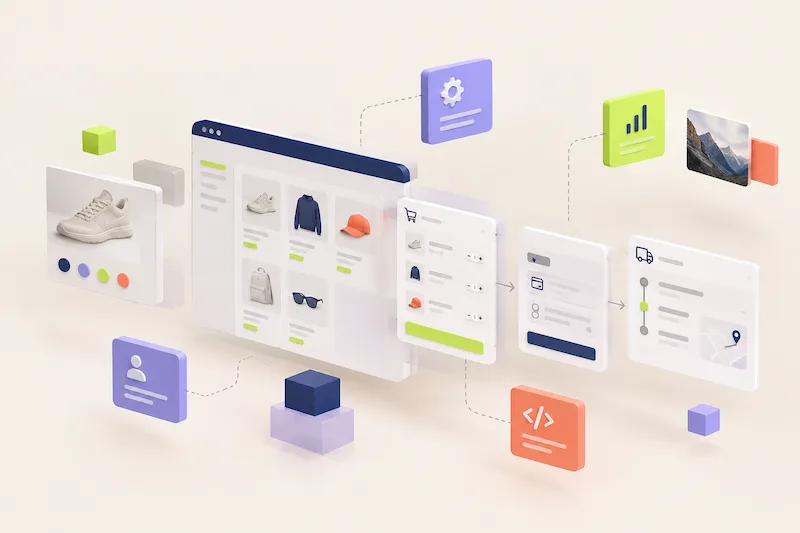
Shopify and custom development together
In practice, many of these conversations end up somewhere in the middle. Shopify handles the selling, which is what it does best, and what's specific to the business is built around it. That might be an ERP integration that keeps stock and orders in sync, a back office for something Shopify doesn't cover, or an app for repeat customers that runs on the same store.
It's the same idea we described when writing about CRM, ERP and custom software. Whatever is common to any business is covered by off-the-shelf tools, which are proven and maintain themselves, and custom development is kept for what really sets the company apart. In e-commerce, that often means leaving the cart and checkout to Shopify and putting the budget into what happens before and after the purchase.
What we look at before recommending anything
What a client wants from this decision is a store that works, holds up as the business grows and doesn't need rebuilding in two years because the wrong foundation was chosen. Getting it right helps a lot when you've built stores of both kinds and seen how each one evolves over time.
That's why the first conversations are more about the business than the technology. We want to know how the company sells today and how it wants to sell in two or three years, because someone planning to open a B2B channel next year needs a different foundation from someone who only sells to consumers. We ask which systems need to talk to the store and who will run it. And we always end up talking about what sets the company apart from its competitors, because that's usually where custom development is worth the investment.
With those answers, it quickly becomes clear what won't fit. A configurator that looks complicated, an integration with an old ERP that has no API, or a catalogue that's going to grow a lot are all things worth knowing before you choose. Sometimes the right call is to recommend the simplest option, even if it's the one that gives us the least work, because a well-built Shopify store that the client runs on their own and that works for years is a good project for us too.
If you're thinking about your store
If you're about to launch an online store, or thinking about rebuilding the one you have, and you're not sure which foundation suits you, we can look at it together before you start. A conversation about how you sell and what the store needs to connect to is usually enough to see which way to go.
